Walk into classrooms using Superstructures and you’ll notice the same thing happening at different grade levels: students are doing the thinking together. Instead of waiting for a hand to go up or for work to be collected later, students are responding as ideas are introduced, seeing how their classmates think, and adjusting their own understanding in the moment.
Eighth grade history teacher Kristi H. already had an outstanding end-of-unit assessment. To capstone the Early Republic unit, her students planned a Dinner Party incorporating key figures from the first four presidencies. They set up a seating chart and explain why they placed certain people next to each other, showing what they understand about the political alliances, personal relationships, and conflicts that defined the era. The assessment was creative, rigorous, and genuinely fun.
But there was a problem: the students didn't actually think deeply. "In the past," Kristi said, "they've put Dolly Madison next to Sacagawea and said, 'Well, they're women, so that's fine.' I'm like, 'No, you're so wrong.'" She showed her students positive and negative exemplars. She gave feedback. It wasn't enough. The students could identify a bad example when they saw one, but then they would turn around and do the exact same thing themselves. She decided to turn this individual writing assignment into a group presentation, but those changes alone wouldn’t be enough.
Kristi began to wonder if Superstructures could help solve her problem. She knew the tool - she'd already used a Dot Plot to help students compare constitutional compromises, and had seen it help students who struggled with how to structure a comparison. She'd even gone so far as to share it with her staff. What she needed was to figure out how to aim it at a specific problem.
So, this year, Kristi incorporated Superstructures directly into the Dinner Party Assessment. She worked with the Superstructures team to co-design a new Dot Plot targeting her core instructional dilemma: getting better feedback into students' hands before they decided to seat William Henry Harrison and Tecumseh together because they'd enjoy talking about the Battle of Tippecanoe.
%20(5).png)
Kristi's New Dot Plot
%20(4).png)
Harrison & Tecumseh pairings
In her new activity, students plotted pre-selected pairs on two axes — how much the two figures would have to discuss, and whether they'd get along or not — earning badges as they worked. The custom badges included one called Dig Deeper, designed specifically to push back against surface-level connections. The Dot Plot was a required brainstorming step before the final presentation began.
Kristi urged students to earn as many badges as possible. The badges became the first-line feedback students needed, freeing Kristi to circulate and actually teach. "When I could start with 'tell me what badges you have,' that cut to the chase," she reflected. She had time to give better feedback, manage interpersonal conflicts, and redirect students who weren't following directions.
The quality of the final presentations reflected the deeper thinking the Dot Plot had prompted. Kristi noted that all of her changes contributed — the group format, the presentation requirement, the overall redesign. But she saw the Superstructure's role most clearly in the quality of the thinking itself. The badges had pushed students toward specificity. When she sat down to grade, she opened Teacher View and wasn't surprised by what she found. "It confirmed what I knew from their presentations," she said. The strongest presentations had earned the most badges in the planning phase. The weakest had not.
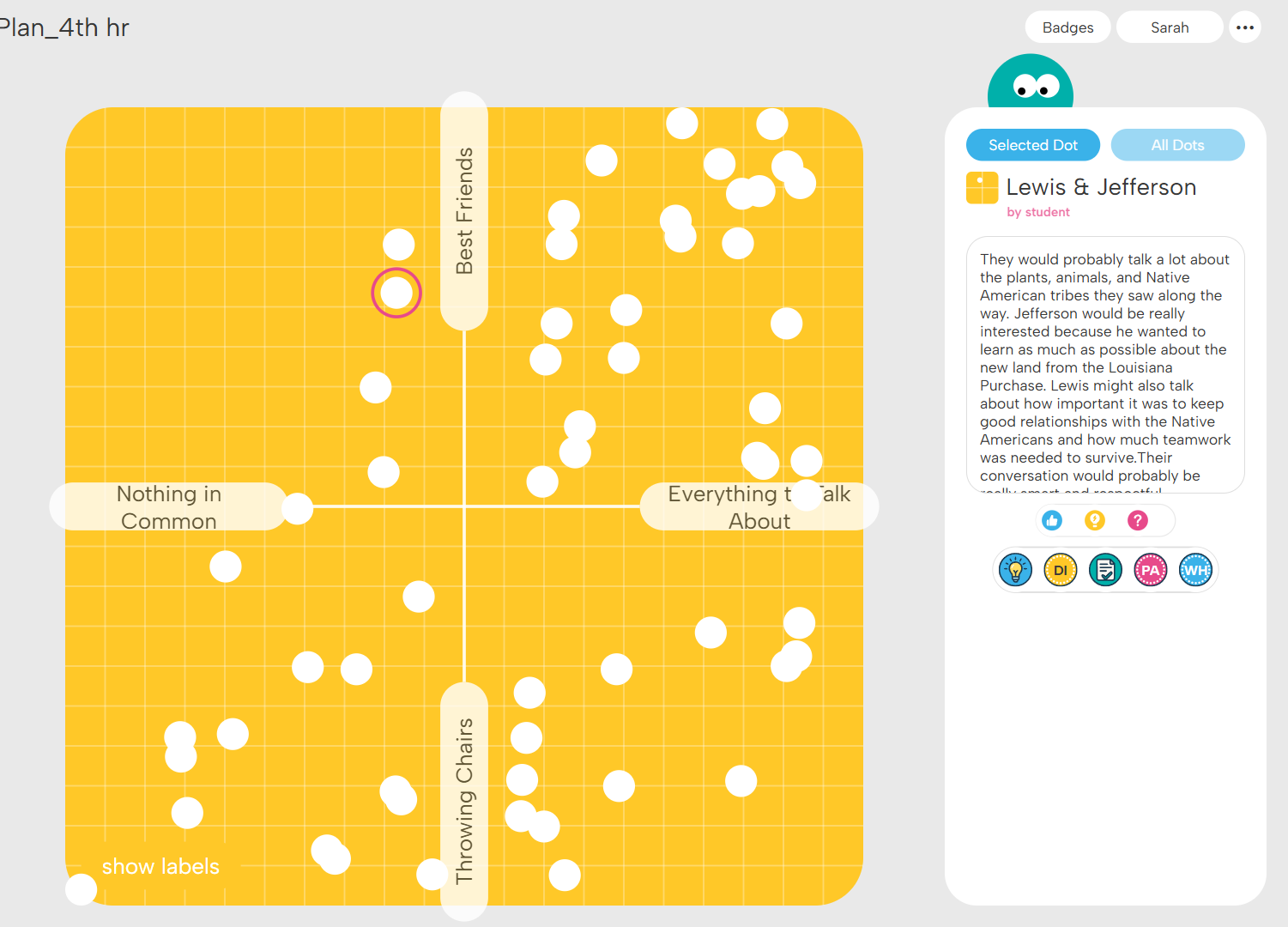
A student entry earning all badges
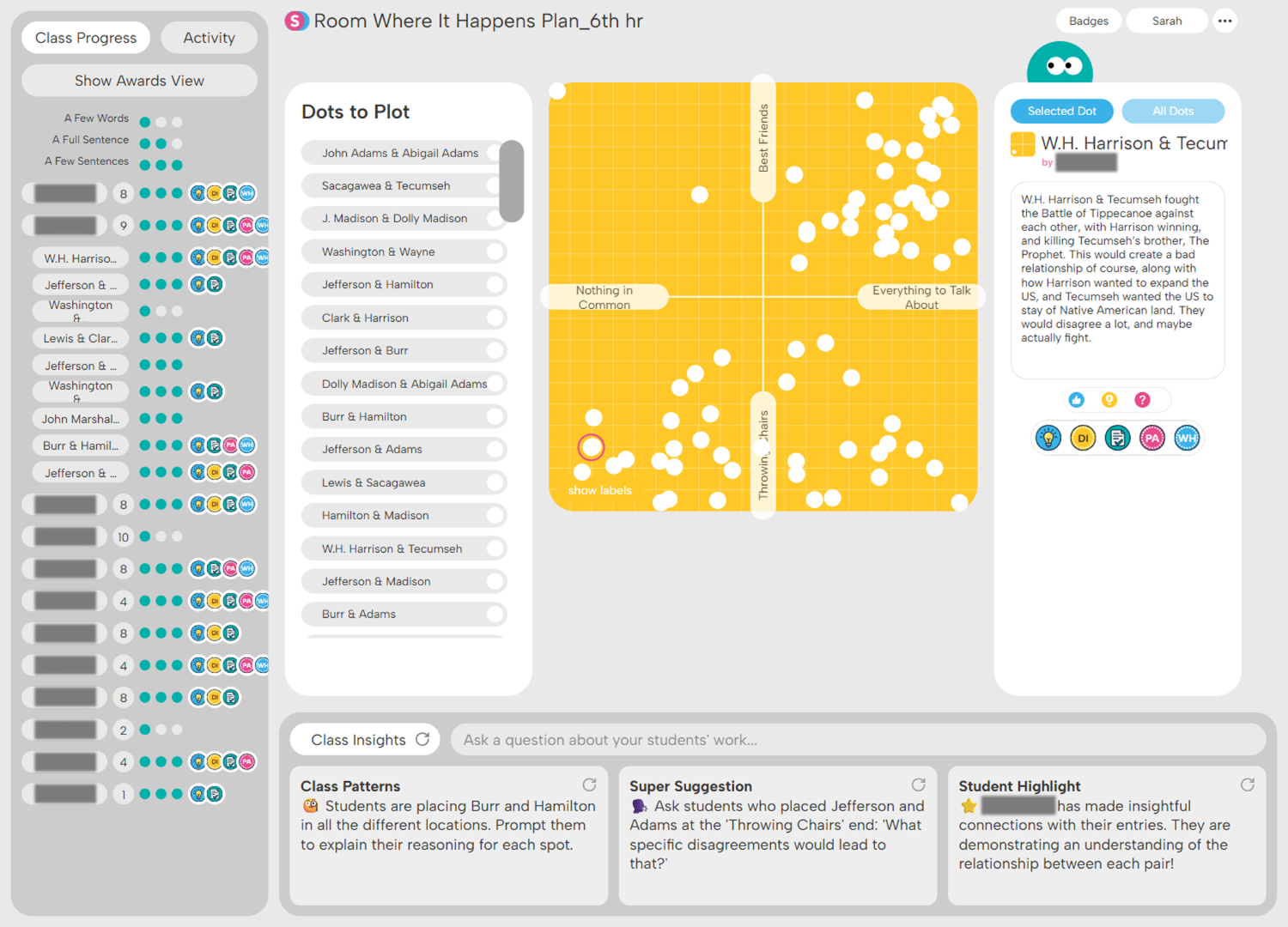
Teacher View (names redacted) for one of Kristi's classes
Kristi is planning to keep the redesigned assignment going forward. She's also taking on English next year alongside History, and she's already looking at what Superstructures has available for that content area. The Dinner Party is still her assignment. It just works better now.
Amy, a 5th grade teacher, used Superstructures to launch a social studies lesson on cooperation and conflict. Immediately, she saw student engagement increase.
“I love this activity because students—once they quickly learned how to post their answer—began writing in their responses,” she said, noting that students even started responding to each other. Amy loved how Superstructures generated participation among her whole class while giving her immediate insight into student thinking, making it an effective hook at the start of the lesson.
She also noticed a shift in classroom energy, with students eager to log on and contribute, often getting excited about their responses and the badges they earned. Amy especially valued how accessible the platform was for both her and her students, emphasizing, “I don't consider myself a very techie person… but from the moment that I got into it and played around with it, I was like, oh, I can do this. This is really simple.”
Amy shares her thoughts
Seth, an 8th grade social studies teacher, first used Superstructures to teach the Reconstruction era and was impressed with the level of student engagement.
Using a Spectrum structure, he asked students to place events from “most impactful success” to “most impactful failure,” which helped them think more deeply about the topic and evaluate Reconstruction as a whole. The classroom energy was high but focused, and students who didn’t normally participate found a voice.
He emphasized that Superstructures “really evens the playing field for your students,” giving all learners a chance to contribute meaningfully. Seth also pointed to its real-time support and versatility, including AI feedback, badges, and a range of structures that keep students engaged. To Seth, the true value of Superstructures is how it makes learning visible to teachers and students, noting that “it all boils down to growth… Superstructures shows you a clear pathway to that.”
Seth shares his thoughts
Britney, a high school English teacher, described her first experience with Superstructures as “so simple.” She wanted to engage 30 students while still giving meaningful, individualized feedback on comparing and contrasting characters in a novel. “It took about 2 minutes to create an account and set up a Venn diagram. And within a couple of minutes, all of my students were on—they were all engaging in the prompt, they were all sharing their thoughts.” Students were so enthusiastic that they asked, “Can we do another Soops, please?” Britney noticed that even quieter students were more involved because they could contribute in real time rather than waiting to be called on. She also valued how seamlessly it fit into her teaching, since it is “designed around the conversations that my students and I are already having in our class.”
Britney shares her thoughts
.png)
Britney's classes compared Whitman and Angelou...
.png)
...and Miguel and Esperanza.
