
Resources
Resources
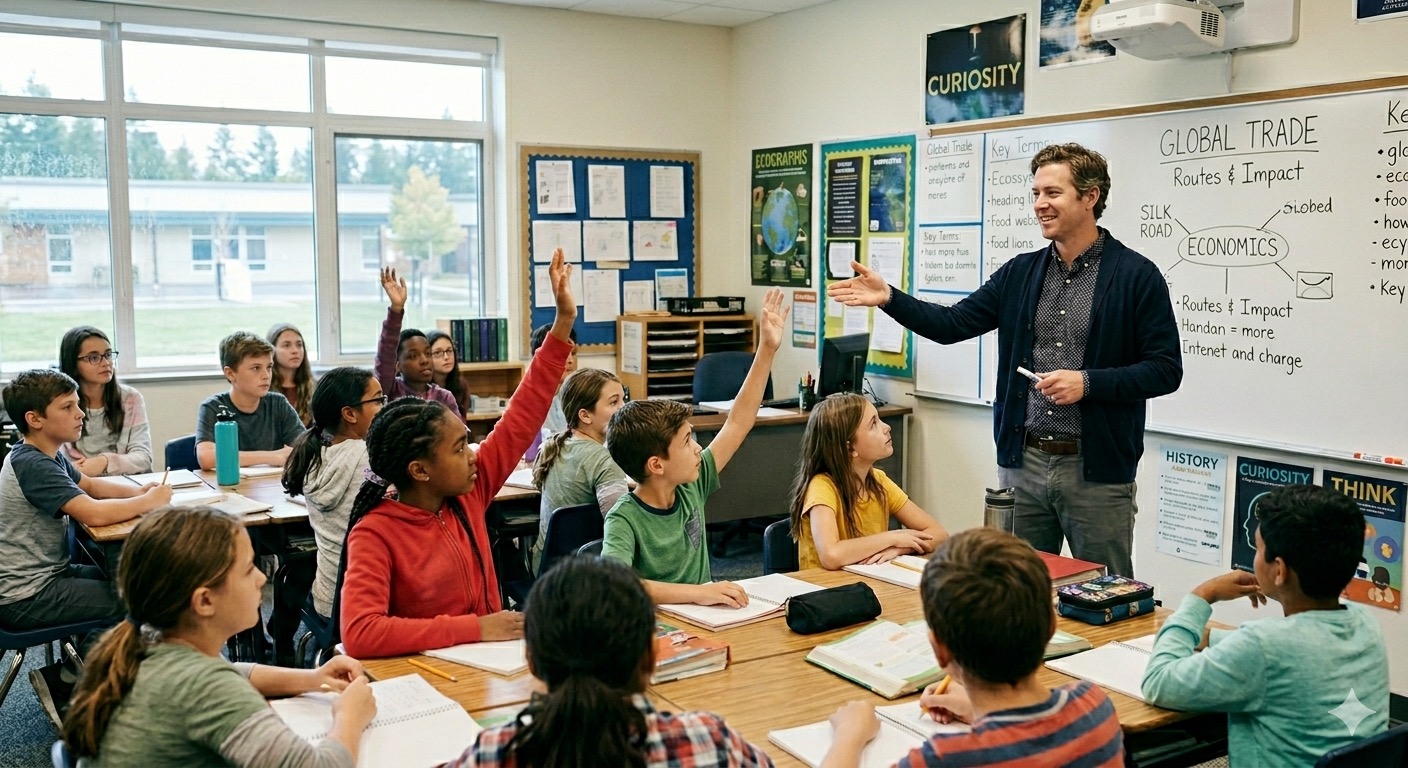
Not all questions are created equal. Some have a single right answer. Others ask students to wrestle with ideas, make connections, and think for themselves. True learning happens at the intersection of foundational knowledge and critical thinking, where facts and inquiry meet. And the questions we ask determine whether students take the journey or just reach the destination.
Closed-ended questions are efficient and precise. Asking “What year did the American Revolution start?” gives students a clear target and allows teachers to quickly check comprehension. These questions are especially useful when clarity and accuracy are essential, and many systems—like state assessments and college entrance exams—reinforce this kind of thinking. But while they ensure students know key information, they often leave reasoning, analysis, and curiosity on the sidelines.
Open-ended questions are where real thinking happens. Unlike questions with a single correct answer, asking “Why do you think communities developed differently along rivers than in deserts?” or “How might the outcome have been different if…” moves students beyond recall and into idea exploration. These questions push students to work through complexity and apply their breadth of foundational knowledge toward mapping a new understanding. And they help them grow into confident, independent thinkers.
In English classrooms, understanding often revolves around interpretation and evidence. Accuracy is not static—in fact, it is not the goal. Students are not expected to know the author’s thoughts; they are encouraged to explore possibilities and construct justifications that make sense. Open-ended questions invite students to become builders of ideas, flipping through texts, annotating, revising, and debating as they refine interpretations with peers. In this process, they shape their own understanding and develop the reasoning skills to defend it.
History classrooms benefit from questions that surface complexity and perspective. Instead of focusing only on what happened, students explore why decisions were made and how different groups experienced the same events. These questions push learners to examine sources, consider bias, and construct arguments. Through discussion, students see history as shaped by evidence and interpretation rather than a fixed set of events.
Science is all about asking questions about the natural world, so why do we teach it as if all the answers are already known? Like history, science is more than describing what happens, but how and why. These are the questions that get students thinking like a scientist. Will their answers always be correct? Probably not. But they will have begun to exercise the mental muscles that are required for real scientific inquiry. Open-ended questions give them ownership of that process, handing them a mystery and asking them to apply their knowledge and reasoning skills to discover something new.
Superstructures amplifies this approach by giving students scaffolds that support them as they work through open-ended questions. Students form an initial idea, write out their thinking, and refine it as they observe what others have written. Once that thinking is on the page, they see how it holds up alongside the thinking of others. A new insight from a peer can surface a gap, challenge an assumption, or push an idea further than it would have gone on its own. Students revise, clarify, and sometimes rethink entirely as they engage with different perspectives. Over time, they come to expect that their first answer is not their final one. That shift changes how they approach questions, moving them from aiming for the “right” answer to doing the real work of thinking.